
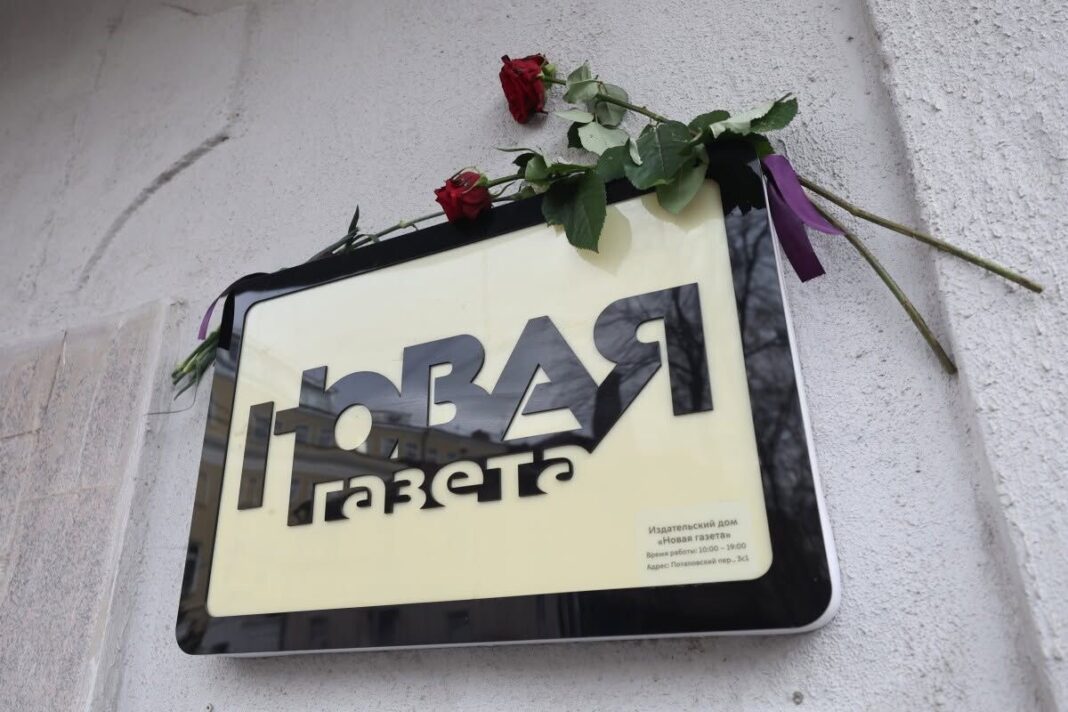

Today, 9 November 2026, the lights went out in the Moscow newsroom of Novaya Gazeta. After more than 30 years, one of Russia’s most important independent newspapers is forced to close. Its final statement is titled: “We have been killed.”
These words should not be read as a metaphor. They describe the systematic destruction of independent journalism by a state that has made telling the truth an increasingly dangerous act.
The closure is the culmination of years of repression: blocked websites, revoked publishing licences, confiscated printing facilities, raids, criminal proceedings, financial isolation and the designation of the newspaper and more than 100 of its journalists and contributors as “foreign agents”.
Russia’s foreign-agent legislation has become one of the most powerful instruments in this machinery. Under the pretext of protecting national sovereignty from foreign interference, the authorities have created a system that stigmatizes independent journalists, imposes restrictive obligations, threatens professional and financial survival and makes virtually any form of public dissent punishable. It is not about transparency. It is about intimidation, exclusion and censorship.
The words of Vera Politkovskaya, daughter of murdered journalist Anna Politkovskaya, in an interview with Irina Nedeva, Vice-President of AEJ (International) for Bulgarian National Radio in Strasbourg, offer a particularly revealing account of what this system has become.

“Everything has been designed to make people keep quiet and do nothing,” Vera told BNR, describing the increasingly restrictive laws targeting anyone whose views differ from the official narrative. Her example is chillingly simple: “I could stand there with a blank sheet in my hand and be arrested for it.”
This is the reality behind the foreign-agent label. It is a system designed not merely to punish journalists after they publish, but to make people afraid before they speak.

There is another, deeply personal reason why the closure of Novaya Gazeta matters so profoundly. It was the newspaper of Anna Politkovskaya, whose courageous investigations into the war in Chechnya, torture and state violence challenged the Kremlin long before many in Europe were willing to recognise the danger.
Twenty years after her murder, the full truth remains concealed. Six people were convicted in connection with the crime, but the person who ordered it has never been identified. Vera Politkovskaya told BNR: “I am absolutely convinced that the person who ordered the murder is being protected by someone.” She added that the truth would not emerge until the current system in Russia disappeared, collapsed or was transformed.
Her words turn the closure of the newspaper into something even more disturbing: the institution that gave Anna Politkovskaya a platform to expose abuses is now itself being silenced by the same repressive system.
Vera also reminded Europeans of something we must not forget: people who oppose the war and authoritarian rule inside Russia cannot simply be expected to resist without understanding the risks they face. As she put it, “people with opposition views who live there can effectively be regarded as hostages of the system.”
For the Association of European Journalists, this is not simply another newspaper closing. It is a warning about what happens when a state succeeds in dismantling the institutions that hold power accountable. It is also a reminder of our responsibility towards Russian independent journalists, including those forced into exile, who continue to inform audiences despite bans, blocks and intimidation.
Vera Politkovskaya made one direct appeal to European politicians: Russian journalists working in Europe must be allowed to do their work without obstruction. Their reporting remains a vital source of information for people inside Russia, where state-controlled media and propaganda increasingly dominate the public space.
We stand in solidarity with the journalists of Novaya Gazeta and all independent Russian journalists who refuse to surrender their professional responsibility.
A newsroom can be closed. A newspaper can be stripped of its licence, its premises and its financial resources. Journalists can be branded foreign agents and forced into exile. But the truth they have documented does not become less true because the state has forbidden its publication.
Anna Politkovskaya paid with her life for defending that principle. Twenty years later, her daughter is still asking for the truth. And today, the newspaper that carried her mother’s voice is being forced into silence.
The closure of Novaya Gazeta must not become the closure of Europe’s attention.
Irina Nedeva, Vice-President of Association of European Journalists (AEJ)