
A bold experiment
Mar 12, 2026 – By William Horsley, AEJ UK Chairman
The Safety of Journalists Platform is the world’s first continent-wide accountability mechanism for monitoring, reporting and protecting the safety of journalists based on a mutual agreement between the 46 states of the Council of Europe and 15 trusted journalistic and press freedom advocacy groups. Some European governments chafe or criticise, but the Platform started up 11 years ago with the consent of the member states, and so it has bridged the chasm that sometimes pits national governments openly against independent media and press freedom bodies.
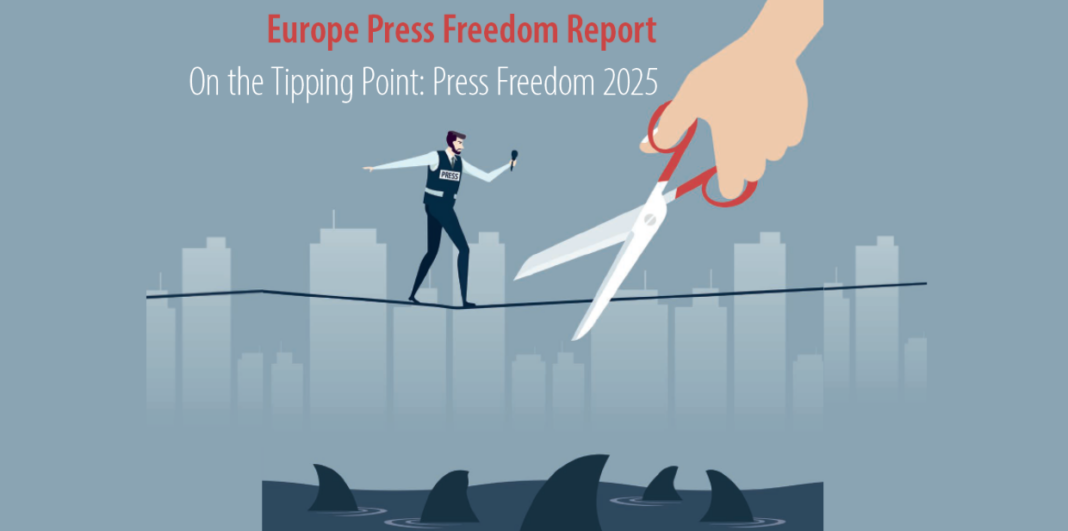
The recently-published annual report by the Platform partner organisations, On the tipping point: Press Freedom 2025 gives a uniquely well-informed picture of the state of media freedom in Europe, including positive policy responses to the major problems identified and recommendations for further actions addressed to national governments, the Council of Europe, and the European Union.
The project is the product of a cultural revolution and a dramatic shift – prompted by pressure from media stakeholders and the Council of Europe’s Parliamentary Assembly, from a primary focus on issuing soft-law Guidelines for member states on media-related issues to mobilising efforts to get those standards implemented in states’ laws and practices.
To date the partners have published over 2,300 verified press freedom alerts, which cover serious threats to media freedom from physical violence and abusive legal threats to arbitrary detention, judicial impunity and other acts that undermine media freedom and independence.

Positive obligations of states
This mobilisation is rooted in the legal concept of states’ positive obligations”, which grew out of landmark rulings by the European Court of Human Rights in cases like the 2007 murder of writer and journalist Hrant Dink in Turkey. Positive obligations require state authorities to put in place effective measures of protection when a media worker faces known threats of violence; and when such attacks do occur to conduct prompt, impartial and effective investigations to bring those responsible to justice.
States also have a general duty to establish a safe and favourable environment for journalists to carry out their work without fear or undue interference – a guideline echoed in many UN resolutions and intrenational texts. The Platform mechanism profits from the Council of Europe’s forums for constructive dialogue, including face to face meetings with the Committee of Ministers (the highest decision-making body), and written exchanges related to Platform alerts in which the partners call for remedial actions such as the repeal of bad laws, averting SLAPPs, and stopping arbitrary attempts to force journalists to disclose their sources.
Another “Factor X” is informal peer pressure which helpful member states can exert on reluctant governments to comply with obligations that flow from the Council of Europe’s Statute and rulings by the court. A so-called “Group of Friends” — a voluntary grouping of member states publicly committed to defending media freedoms — has grown to include eighteen member states.
Is it working?
The Platform’s database of over 2,300 alerts is an oiutstanding resource for tracking trends and the relative performance of member states, and guiding informed policy responses. But only one in five of all the alerts over 11 years have triggered adequate remedial actions by governments which have allowed alerts on individual cases to be declared “Resolved”. That is plainly not good enough. Last year saw a precipitate worsening of conditions for media workers in Azerbaijan, Georgia and Serbia which contributed to a darker picture. At the end of 2025 148 journalists were in detention in 7 European countries, and in 51 recorded cases when journalists were killed for their work those responsible have not been brought to justice.
This annual report sets out damning evidence of states using intimidation, spyware, transnational repression, vague and sweeping laws, and systematic deprivation of liberty as tools to control and curtail free media. Fewer than half of the more than 330 alerts posted on the Platform last year even received a written response from the member government concerned.
In 2023 another high-profile innovation began: a 5-year Council of Europe-led Journalists Matter campaign, aimed at galvanising public support for journalists’ safety and legitimate media freedom by engaging all sectors of society. More than half of the 46 member states have set up National Committees bringing together state and non-state actors to take the campaign forward, and a dozen have launched Action Plans with publicly declared intentions including policy reforms and mechanisms of protection.
An interim study of the campaign’s impact found a mixed picture but a ‘growing recognition by policy-makers of the need for systemic actions’; and a widespread will to understand or emulate successful ventures such as the Netherlands’ Persveilig (‘press safety) initiative, which coordinates actions by police, prosecutors, media editors and journalists to counter violence and aggression against media workers.

William Horsley, representing the Association of European Journalists, with other Platform partners (RSF, Index on Censorship, International Press Institute & Justice for Journalists) at the London launch of the report
A declaration of faith
The Platform’s work is a powerful statement of faith in the European Convention system, and by extension in international law in an age of ‘wrecking ball politics’ and of short-sighted public derision of international courts. Platform alerts are rooted in the authoritative case law of the Strasbourg court, which have routinely proved their worth as a shield against abuses of state power. They have provided hundreds of journalists with a means to challenge arbitrary acts of discrimination or denial of their rights.
The Council of Europe acted swiftly to uphold Europe’s civilisational values by expelling Russia within weeks of its illegal invasion of Ukraine in 2022. And the Council of Europe’s policy expertise assisted the European Union to adopt legally binding directives on SLAPPs and the European Media Freedom Act.
The United Kingdom government might have done well to heed the advice of the Council of Europe’s Commissioner for Human Rights, Michael O’Flaherty, who last year urged it to review current protest laws after mass arrests at protests against the ban on Palestine Action. This year the UK High Court ruled that prohibition on the group illegal.
Looking ahead
The partners’ newest set of recommendations call for decisive action to combat legal harassment, safeguard public service media, counter media capture and prioritise protections for women journalists. They point to a widening gap between public commitments and effective protection, and call for high-level political leadership so that verbal pledges translate into measurable actions.
The Platform’s wide remit and detailed records over more than ten years provide a unique and accessible resource for state authorities and media stakeholders alike. This report serves both to reveal the brutal misuse of judicial and police power to cripple independent news media in Baku, Tblisi and Belgrade, but to direct fresh attention to the ongoing impunity surrounding the unresolved killings, among others, of Daphne Caruana Galizia in 2017, Jan Kuciak in 2018, and Giorgos Karaivaz in 2021.

Photo Credit: Council of Europe. Giorgos Karaivaz – Greek journalist murdered in 2021
On the publication of this report Azeri journalist Gunel Safarova declared: “Solidarity [with harshly oppressed journalists] must be concrete and bold. If it is ignored, not only populations in countries like Azerbaijan suffer, but the whole European framework of human rights will be in danger.”
This article is based on William Horsley’s presentation at the UK Media Freedom Forum held at City St George’s University, London on 5 – 6 March