

Hate. Threats. Intimidation.
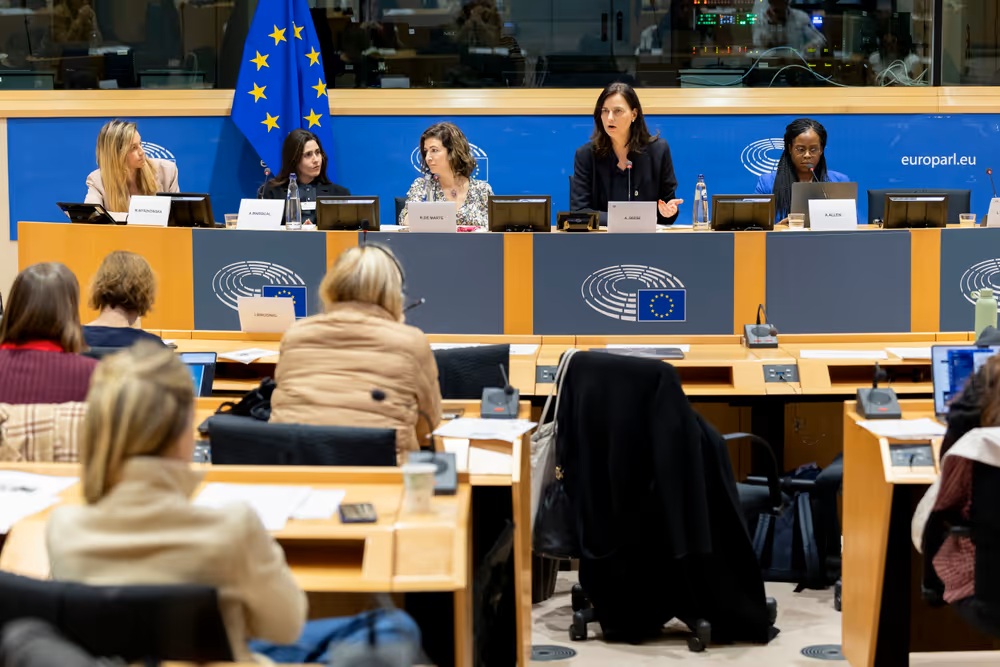
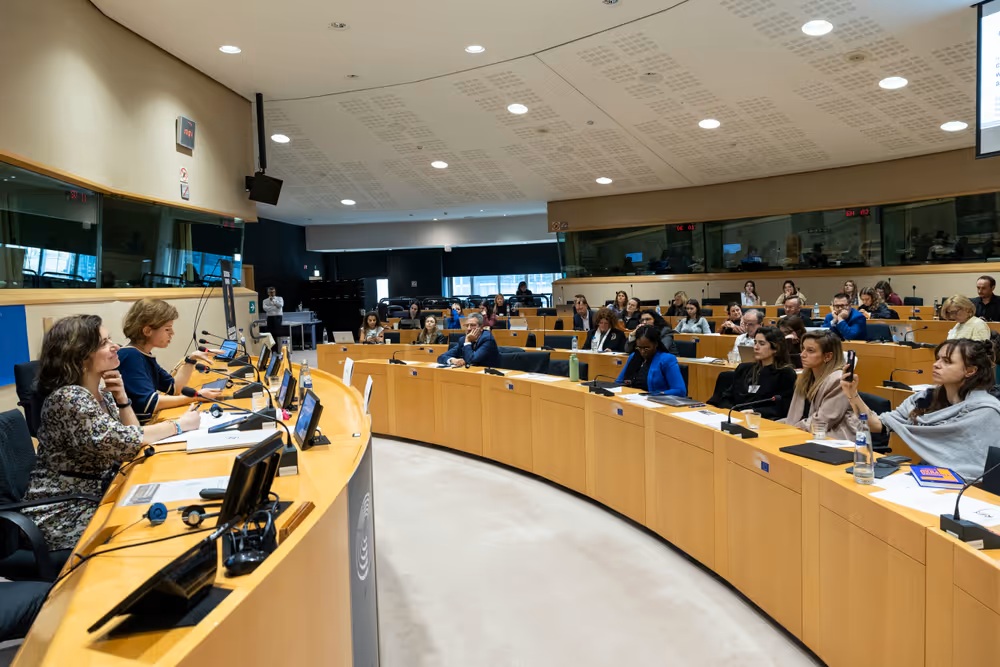
Digital violence against women is an issue that is increasingly affecting journalism. On Thursday, March 5, the European Parliament in Brussels invited journalists to a seminar on “Digital Violence against Women.” Among the participants were several members of the Association of European Journalists (AEJ) from Greece, Bulgaria, Romania, Slovakia, and Austria.
Debate, Data, and Deepfakes
The formal opening took place on Thursday morning with a meeting of an interparliamentary committee on International Women’s Day 2026. Keynote speakers included Lina Gálvez, Chair of the Committee on Women’s Rights and Gender Equality; Hadja Lahbib, EU Commissioner for Equality, Preparedness and Crisis Management; and Florence Raes, Director of the UN Women Liaison Office in Brussels. Guest speakers included Natalia Waloch, journalist for the Polish newspaper Gazeta Wyborcza and the magazine Wysokie Obcasy; Anna Natsvlishvili, Georgian Member of Parliament; Silvia Semenzin, media researcher at the Universitat Oberta de Catalunya; Julie Guichard, Digital Safety Government Affairs Manager at Microsoft; and Carlien Scheele, Director of the European Institute for Gender Equality (EIGE). Closing remarks were given by Josie Christodoulou, Commissioner for Gender Equality, and Lina Gálvez again.
Hate that multiplies digitally
At the heart of the debate was digital violence against women and girls, a phenomenon that has reached new dimensions through social networks, platforms, and artificial intelligence. “Technology is not the cause of the problem, but it scales it,” warned Silvia Semenzin. The development of deepfakes is particularly alarming: Around 96 percent of all deepfake content is pornographic, and 99 percent of the victims are women or girls.
Platforms under pressure
Large technology companies are also increasingly bearing responsibility. Julie Guichard from Microsoft emphasized that once images are published, they can spread incredibly quickly. “As soon as an image is online, it can spread across the entire internet.” Microsoft is therefore working with digital fingerprinting and collaborations with NGOs. When a problematic image is reported, it receives a digital hash value, which is shared with partner organizations. This prevents identical content from being uploaded again. For Carlien Scheele of the European Institute for Gender Equality, one thing is clear: Digital violence doesn’t exist in a vacuum. “It’s based on existing stereotypes and power imbalances.” The consequences are real: Women delete accounts, change their phone numbers, or withdraw entirely from public debates. Some even change their workplace, place of study, or place of residence.
Political Appeal from the European Parliament
A clear appeal also came from the European Parliament. “We are not a minority, we are the majority,” emphasized Lina Gálvez. There are around ten million more women than men living in the European Union. Nevertheless, women in the public sphere continue to be significantly more often the target of digital violence.
When Female Journalists Become Targets
How these developments specifically affect the daily work of journalists was the topic of the subsequent seminar, “Digital Violence against Women.” The focus was particularly on female journalists, who are increasingly becoming the target of coordinated online campaigns. Hate speech, threats and intimidation are now part of the professional risk for many of them.
When Hate Forces Women Out of Politics
Another focus of the seminar was digital violence against female politicians. Former Slovak President Zuzana Čaputová, who participated via video link, spoke about her own experiences with online hate—and how her daughters have also become targets of attacks. The message from many perpetrators is clear: “Be quiet, be small, stay out.” When young women see the attacks female politicians experience online, many consciously decide against a political career. This makes digital violence a problem for democratic participation.
Platforms and Regulation
Finnish MEP Sirpa Pietikäinen pointed out that traditional media are subject to strict regulations. However, such standards are often still lacking for social media platforms. Without clear regulation and consistent implementation of European digital laws, digital violence will hardly be contained. Carlos Farinha of Portugal, President of the Commission for the Protection of Victims of Crime, emphasized that digital violence is not a conflict between men and women, but a social and cultural problem that must be combated comprehensively.
When Reach Becomes Toxic
Spanish influencer Raissa Sali offered very personal insights. Because she moves between different communities, she faces hostility from various quarters. She is particularly critical of TikTok, which she describes as the “most toxic” of the major social networks. Despite its greater reach, she eventually left the platform because the attacks became too intense.
New Challenges Due to Digital Radicalization
Several presentations also pointed to a growing problem: the radicalization of young men online. Studies show that a segment of Generation Z is increasingly adopting misogynistic narratives. Such ideologies spread rapidly in online subcultures and often reach very young users. Even girls as young as nine can be targets of sexual harassment or digital violence online.
When Threats Trigger Trauma
The event concluded with a keynote address by Austrian journalist and author Ingrid Brodnig, who presented her book “Women as Enemy Images.” She emphasized that online hate frequently contains sexualized threats. These are often formulated indirectly, but have the same effect on those affected as overt threats of violence.
For many women, such messages are particularly distressing because they connect to real-life experiences. One survivor reported that online threats trigger strong physical stress reactions in her even years after a rape. Digital violence thus forces many women to relive traumatic experiences again and again.
An attack on democracy
Studies also show that women become significantly more cautious or withdraw from public debates after hate campaigns. This is no longer just about individual victimization. When voices are systematically intimidated, the public discourse itself changes. The central finding of the seminar is therefore: Digital violence against women is not a fringe problem of the internet. It is a structural social problem – and a challenge for democracy. Or, as Lina Gálvez put it: “We are not a minority. We are the majority.”