
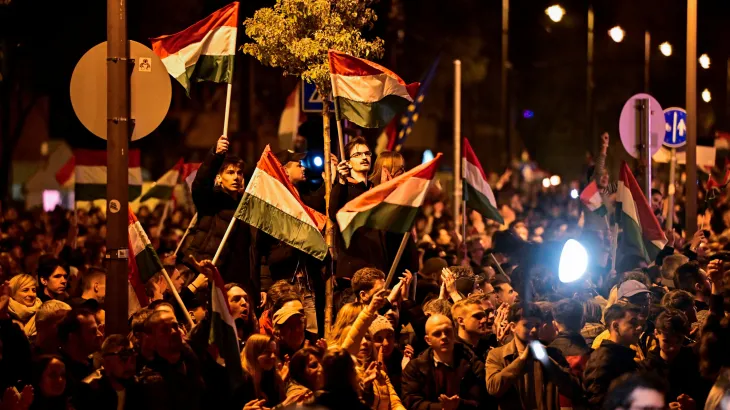

On April 13th, AEJ organized a Zoom-conference about the outcome of the Parliamentary elections in Hungary which also have a major European dimension. It was a defeat of an autocratic, corrupt, anti-European and pro-Russian regime established by Viktor Orbán during the last 16 years in power.
3 experts from Hungary were present and answered questions from more than 20 AEJ-members from different sections:
Dr. Jozsef Martin, Hungarian journalist since 1967. Professor emeritus
Metropolitan University Budapest and Esterházy Károly University, Eger, Member of Hungarian AEJ-section
Dr. Gábor Polyák, Media studies scholar at ELTE University, Budapest
DDr Péter Techet, Research fellow at the IDM, Vienna. Presented a study on the electoral system in Hungary last week: https://www.idm.at/scenarios-for-the-2026-hungarian-parliamentary-elections/
Here is a report by „Austrian Press Agency“ (APA) supplemented by the moderator and organizer of the debate, AEJ-Vice-President Otmar Lahodynsky
Hungary – Experts expect Magyar to bring about a shift in foreign policy
And shake-ups in the country’s key institutions
Budapest/Brussels/Vienna (APA) – Hungarian experts expect that the pro-European winner of the Hungarian parliamentary election, Peter Magyar, will first ‘clarify’ Hungary’s foreign policy relations. Magyar will be a reliable partner for EU and NATO allies, said Hungarian journalist and professor emeritus Jozsef Martin on Monday evening during a discussion organised by the Association of European Journalists (AEJ).
Magyar intends to visit Warsaw first, then Vienna and then Brussels, said Martin. “The flirtations with Putin’s Russia will come to an end.” However, Hungary’s dependence on Russian gas and oil supplies will continue for years. Magyar will also seek normal cooperation with neighbouring Ukraine.
Poland is very important for Hungary, explained Péter Techet, a research fellow at the Institute for the Danube Region and Central Europe (IDM). The TISZA-party-leader also intends to extradite the former Prime Minister of Macedonia (now North Macedonia), Nikola Gruevski, as well as politicians from Poland’s former ruling party, the PiS, all of whom were granted political asylum under the previous Prime Minister, Viktor Orbán. Vienna is symbolically important to many Hungarians as a “gateway to Western Europe”. Whilst Orbán had only maintained good contacts with Austrian right-wing nationalist party FPÖ, Magyar could now also re-establish good relations with the Austrian federal government. “Magyar will be pro-European,” said Techet. ‘He has every legal means at his disposal to meet the EU’s requirements.’ However, Magyar is no supporter of the idea of a ‘United States of Europe’ – he wants to preserve the nation states.
The restoration of the rule of law in Hungary is closely linked to the population’s desire for a better economic situation, said Martin. He compared the significance of the billions in EU aid frozen by the EU for Hungary to that of the US Marshall Plan after the Second World War. In the first few weeks of his term, Magyar will also replace the heads of Hungary’s key institutions, as he will otherwise be unable to make progress with his reforms. In this context, the EU could use the frozen funds as leverage, for instance to persuade Magyar to disburse the €90 billion loan to Ukraine or to agree to the EU asylum pact.
Martin also expects the government to amend the constitution, “and I am almost certain that we will get a new head of state”. President Tamás Sulyok had been supported by Orbán’s Fidesz; in Hungary, the president is elected by parliament. “Of course, that will be a tough battle.”
Media scientist Gábor Polyák from ELTE University in Budapest said that Fidesz’s biggest mistake had been that the ruling party had believed its own pro-government polls and its own narratives right up to the end, whilst the propaganda had failed to resonate with many ordinary people in Hungary. “It was only last night that Orbán’s inner circle came face to face with reality.” The Hungarian economy has deteriorated since the Covid pandemic, and in 2024 Fidesz also suffered a severe loss of public trust when the then President, Katalin Novák, pardoned a supporter of a paedophile children’s home director who had been convicted of complicity. That was the reason why Peter Magyar left Fidesz-party and started his own career in the new TISZA-party which functioned first like a start-up-company.
The experts did not rule out that there will be judicial procedures against Orbán and his cronies. But for that aim Magyar has to reestablish the rule of law and replace the pro-Orbán-judges in the Supreme court. Magyar has to do a lot of reforms. Hungarian economy has to be revived and Magyar will try to deblock the EU-assets of 20 billion Euro frozen because of deficiencies in the Hungarian judicial system and a record corruption. The bad Hungarian health-system also needs reforms. There will have to be soon a complete overhaul of the media landscape. The state-broadcaster MTV followed the instructions of the government to report only favourably about it. Till now there has never been an interview with Orbáns opponent, Péter Magyar.
Magyar will continue the rigid regulations in Hungary against migration, Techet said. As for relations with Ukraine, which served as scapegoat for Orbán, he will lift the Hungarian opposition to the EU-loans of 90 billion Euro- where Hungary will not take part in payments. Magyar said that he is not in favour of a swift EU-membership of Ukraine. But his course will be definitly pro-European, the experts agreed.
Otmar Lahodynsky