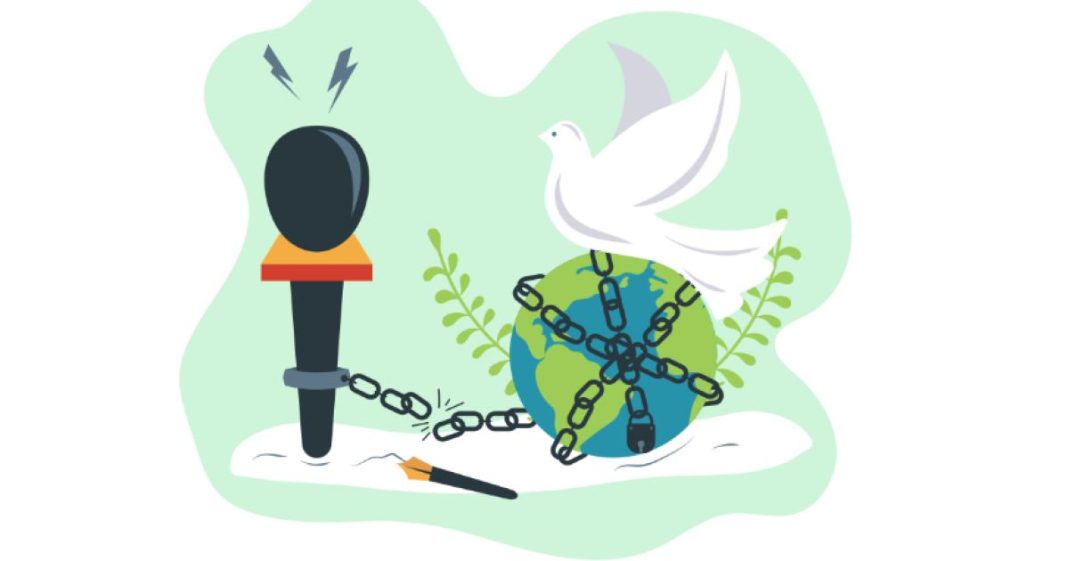

On “World Press Freedom Day”, journalists’ associations are lamenting an increase in political and financial pressure on independent media
By Otmar Lahodynsky, Honorary President of the “Association of European Journalists” (AEJ)
Once again, there is little cause for celebration. 3 May is “World Press Freedom Day”, but media outlets and journalists worldwide – and increasingly in Europe too – are coming under pressure. A new report by the Council of Europe, to which the “Association of European Journalists” (AEJ) contributed under Vice-President Irina Nedeva, laments a „tipping point“ in independent reporting. Political influence over public service broadcasters – coupled with financial pressure – is on the rise in many countries. Even physical attacks on journalists have been recorded, such as the car bomb attack on Sigfrido Ranucci, an investigative journalist with Italy’s RAI. Structural reorganisation is often used as a pretext for purges, as was previously the case in Hungary and Poland, and is now happening at Slovak Radio and in Bulgaria. Autocratic governments no longer need to censor individual programmes when their henchmen are sitting in the boardroom.
Public service broadcasters under pressure across Europe
Added to this is financial pressure: in the Czech Republic, the new right-wing government has called into question licence fee funding. In Belgium, the French-language broadcaster RTBF faces the threat of privatisation. Following a series of scandals, the British BBC is grappling with cost-cutting measures and staff reductions.
In Austria, too, the right-wing party FPÖ has declared war on the licence fee. However, if the ORF has its annual budget approved directly by the government, political influence increases at the expense of independent reporting. For the FPÖ, the media control under the now-deposed Prime Minister Viktor Orbán also served as a model. Hungarian media outlets were bought up or shut down by Orbán’s oligarchs and served only to disseminate state propaganda. Journalists were expected to publish government decisions without comment, as they had no mandate from the voters to criticise, argued the Fidesz government.
In Turkey, many journalists are being sentenced to long prison terms under a questionable “disinformation law”.
EU reacted late
The European Commission reacted late to the threats to media freedom. Last year, the European Media Freedom Act (EMFA), which is intended to safeguard independent reporting, came into force. It also contains recommendations on the funding of public service broadcasters and the protection of journalists, including against strategic lawsuits against public participation (SLAPP), which are used to intimidate critical media through high claims for damages.
Social media on US platforms has put European media under severe pressure. In particular, it has taken a large share of advertising away from print media and has long reposted their reports without payment. Short-sightedly, many print media executives focused too long on the number of ‘clicks’ and underestimated the online competition.
However, the cardinal error occurred under US President Bill Clinton, when he relieved American platforms of responsibility for posted content.
Trump muzzles the media
In the US, where a free press was once part of the national identity, political pressure on journalism has increased under US President Donald Trump. He has brought critical broadcasters to heel with multi-million-dollar lawsuits and threats to revoke their licences, and has personally pocketed compensation payments secured through court settlements. He has just threatened the broadcaster ABC – where comedian Jimmy Kimmel made jokes about his wife Melania – with the revocation of its licence by the broadcasting authority.
In a commentary in the US magazine “Foreign Affairs”, key questions were raised regarding the rise of authoritarianism and how to combat it in its article: “What Can Reverse Democratic Decline?”
“Should journalists be mere chroniclers of democratic demise under the guise of neutrality? Are they just going to watch democracy crumble while pretending to stay neutral? Or should they be the vanguard of a civic-oriented journalism that declares its bias for democracy?
Prof. Otmar Lahodynsky was an editor at Austrian magazine “profil” and deputy editor-in-chief and EU correspondent for “Die Presse”. He headed the Association of European Journalists (AEJ) from 2014 to 2020 and now is its honorary president and Vice-President.