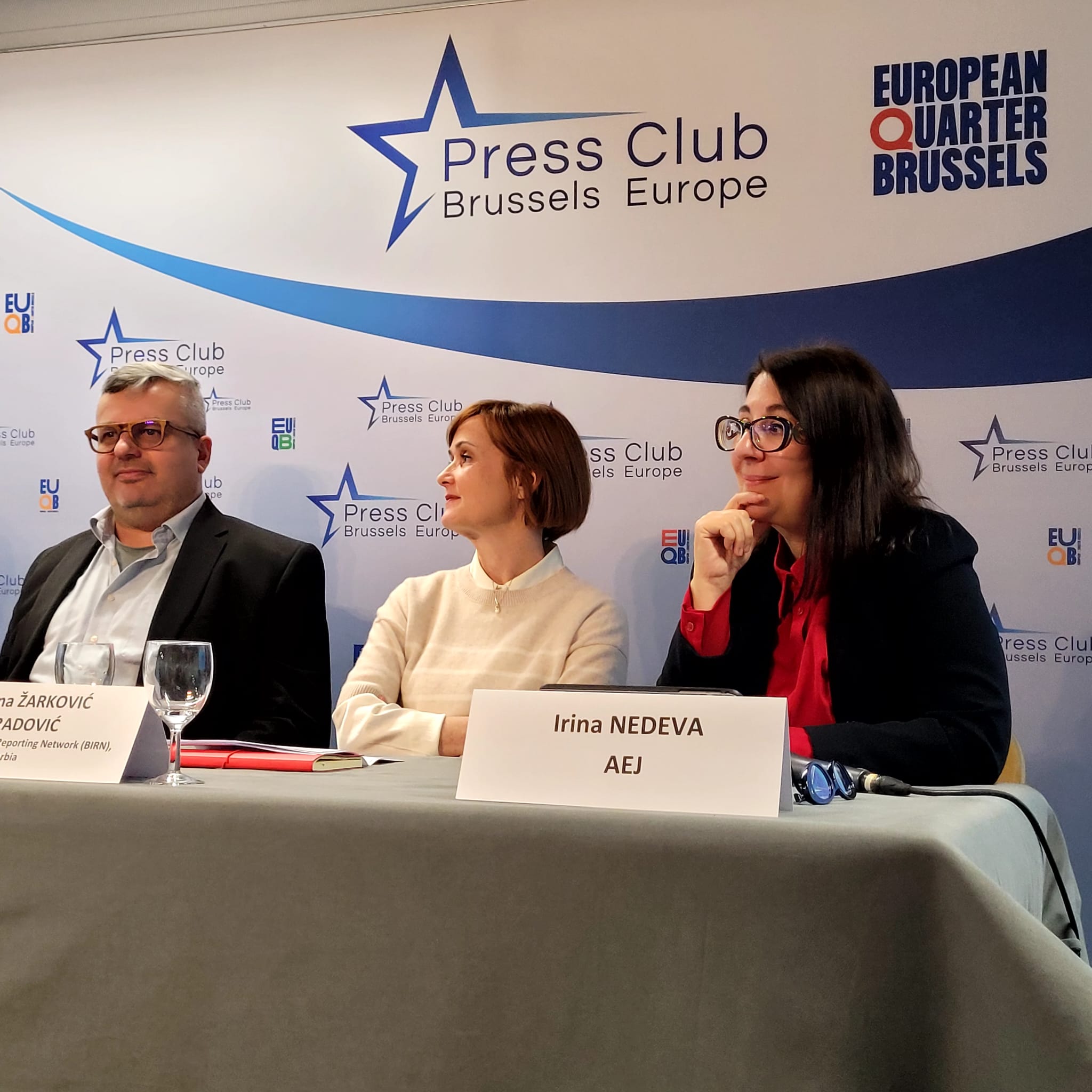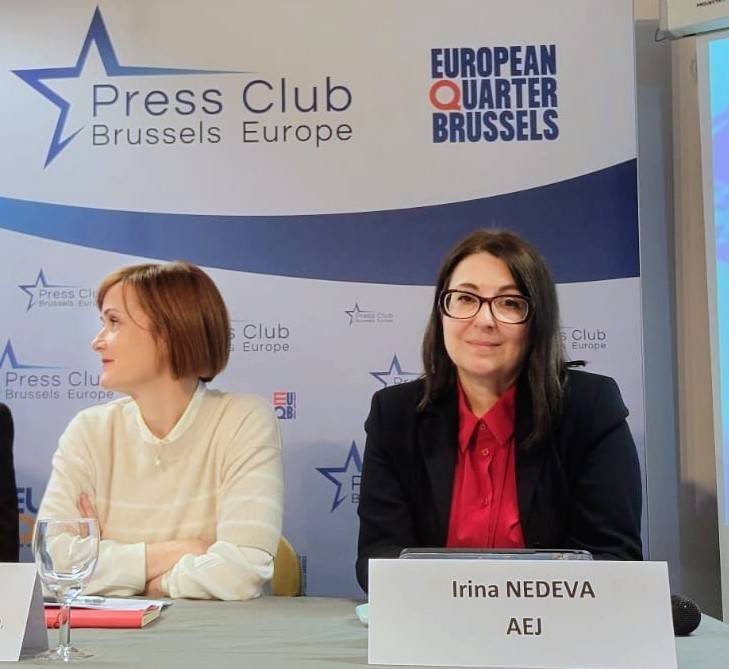

Author: Irina Nedeva, Vice-President of AEJ; Special Representative on Media Freedom. Public Radio journalist and documentary film maker with extensive experience in public media in Bulgaria.
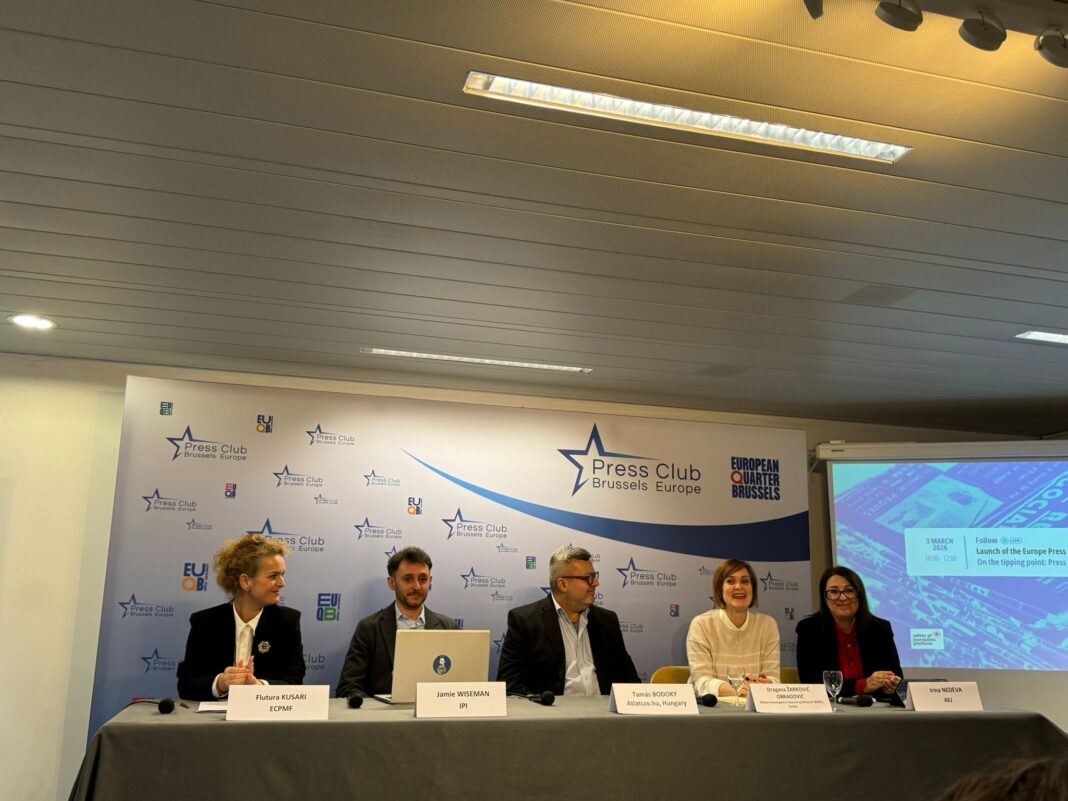
The Europe Press Freedom Report on 2025 which was officially launched on 3rd of March 2026 in Brussels and London provides a comprehensive look at the deteriorating state of independent journalism across the continent during the previous year. Published by the Council of Europe’s Safety of Journalists Platform, the document highlights a dangerous “tipping point” caused by state-driven media capture, restrictive “foreign agent” laws, and the persistent detention of reporters in nations like Russia, Belarus, and Azerbaijan.
It specifically details how political interference and financial instability have undermined public service broadcasters, while investigative journalists face escalating physical threats and legal harassment. The report also examines the impact of global political shifts and the dominance of big tech on the news ecosystem, urging member states to adopt protective legislative frameworks. Ultimately, the findings serve as a call to action for stronger judicial consistency and international cooperation to safeguard the fundamental right to free expression. AEJ publishes the speech of Irina Nedeva, the AEJ Media Freedom Special Representative and Vice-President of AEJ on the topic of Political and financial pressures on Public Service Media, during the launch of the Report in Brussels.
The Systemic Nature of the Crisis
In 2025, the Council of Europe’s Platform partners made a definitive shift: following the 2024 introduction of so-called ‘systemic alerts’—which initially identified recurring patterns in defamation laws—we began analysing pressures on Public Service Media (PSM) not as isolated incidents of political friction, but as systemic threats.
Why is this distinction vital? Because the gravest risks to media freedom today are no longer just external attacks; they are embedded in the very design of governance and funding frameworks.
PSM acts as the intersection where all major threats in this report collide.
We see media capture when governments appoint proxies to PSM boards. We see economic precarity when budgets are frozen to punish critical reporting.
We even see physical safety risks, as evidenced by the car bombing of RAI’s Sigfrido Ranucci. Analyzing the threats against the PSM as systemic allows us to see it as the early indicator of potential danger or failure, as a canary in the coal mine —when the state-funded watchdog is silenced, the entire democratic ecosystem is at a tipping point.
The Governance Trap: Mergers and Purges
The report highlights a disturbing “template” for undermining PSM independence: structural reorganization used as a pretext for political purges.
In Slovakia, the government dissolved the existing broadcaster to create a new entity, STVR, under a model that allows more political influence over leadership without safeguards.
Bulgaria has also become a case study in 2025. At the heart of the pressure on Bulgarian National Television was a prolonged leadership deadlock that led to almost a full mandate of the general director over his term. What might look procedural has turned into paralysis, compounded by court appeals and disputes that have effectively frozen the broadcaster’s governance for more than 3 years which equals a full term for the general director without a proper election procedure. Just a week ago after a final decision of the Court the new competition for the position has been fulfilled with an election of a new general director this time supported by 3/2 votes of the regulator body.
When leadership is stuck in limbo, independence becomes fragile by default.
In Georgia, we saw the human cost of this structural pressure. Journalists at the Georgian Public Broadcaster, like Vasil Ivanov-Chikovani and Nino Zautashvili, were dismissed after publicly protesting political interference and the promotion of anti-EU rhetoric and after expressing solidarity with their jailed colleague Mzia Amaglobeli.
In Türkiye, Public media governance has been placed under direct presidential control, stripping the broadcaster of its autonomy and pluralism.
This is the “Architecture of Silence”: you don’t need to censor every news story if you have already secured the “correct” leadership through structural “reforms”.
The Financial Chokehold: Independence in Name Only
The second pillar of this systemic threat is the financial chokehold. The report is clear: independence without adequate, predictable funding is “independence in name only” as stated by EBU.
We see this in Poland, where the proposed budget for the public broadcaster is among the lowest in Europe at just 0.06% of GDP.
In Bosnia and Herzegovina, BHRT was on the brink of collapse at the end of 2025, facing possible shutdown and the loss of 700 jobs due to a chronic lack of sustainable financing. We have just seen a few days ago, in the last week the black screens of BHRT as a form of a protest.
Even in stable democracies like Switzerland, a reduction in licence fees was threthening the broadcaster to cut 900 positions. The referendum on the fees and funding of public media showed that the Swiss society is ready to support strong public media which is not exactly the case in countries where the levels of distrust in the public institutions and disinformation are high.
When funding is discretionary or subject to yearly political approval—as we see in Lithuania with its sudden budget freezes—it becomes a leash. A broadcaster that must beg for its budget every year is a broadcaster that cannot afford to offend the hand that feeds it. Even more, the Report states that: “In Lithuania there are growing concerns after a state audit of LRT, ordered by Parliament, followed by rushed laws that froze its budget, changing a funding model that had protected its independence since 2015. It happened in a tense political climate. At the end of 2025, Parliament went further, passing amendments that make it easier to remove LRT’s Director General — lowering the voting threshold, introducing a secret ballot, and dropping the requirement to justify the move in the public interest. Critics warn this weakens key safeguards against political pressure”.
In Czechia, the new governing coalition has reignited worries about political pressure on public media. The previous government had changed the rules for appointing the oversight council to shield broadcasters from interference and approved the first licence fee increase in almost 20 years — extending it to internet-connected devices. That helped Czech Radio and Czech Television, but it didn’t fully make up for two decades of shrinking real value. After the 2025 elections, the new coalition announced plans to scrap the licence fee altogether, calling it a cost-saving move — a proposal that critics warn could seriously affect the independence and quality of public service media.
In Belgium, the French-speaking public broadcaster RTBF has come under pressure from Georges-Louis Bouchez, leader of the Mouvement Réformateur, a party in government. He publicly floated the idea of privatising — even “abolishing” — RTBF, and was criticised by journalists’ groups over alleged threats in a leaked call. He says his remarks were misread. His party also threatened to boycott the newsroom. At the same time, funding was targeted: indexation was scrapped and a planned 2% increase frozen. In response, RTBF approved a €132 million savings plan in April 2025, including staff cuts through not replacing retiring employees.
Captured Media vs. “Anti-Media”
We must also address the most extreme end of the spectrum: Media Capture.
In Hungary, the ruling party has consolidated a system of near-total control, using PSM as a vehicle for government messaging rather than public-interest news.
The report introduces a chilling concept from scholar Ayala Panievsky: “Anti-Media”.
In authoritarian environments like Russia and Belarus, state broadcasters have been entirely subordinated to the executive, functioning as propaganda instruments that exclude all dissenting voices. These “anti-media” outlets don’t just conceal information; they actively spread disinformation and incite hate speech, destroying the norms that underpin European democracy. This is the ultimate destination of unaddressed systemic pressures: the transformation of a public service into a state weapon.
When we draw a conclusion at the end we have to go back to the concept of the
The Shield and the Choice
Europe stands at a critical juncture. The European Media Freedom Act (EMFA), which came into full force in 2025, offers a regulatory “shield”. It mandates stable funding, emphasizes on editorial independence and prohibits political interference in PSM governance.
However, as the report notes, this shield is only as good as its enforcement and we have to see EMFA as a Litmus Test: Effective implementation of the EMFA is the only way to reverse this trajectory.
The ultimate question posed by the Report findings is one of identity for journalists within the institutions of Public media. This question is formulated in the article of Foreign Affairs “What Can Reverse Democratic Decline?”
and deserves a quote: “Should journalists be mere chroniclers of democratic demise under the guise of neutrality? Are they just going to watch democracy crumble while pretending to stay neutral? Or should they be the vanguard of a civic-oriented journalism that declares its bias for democracy?”*
To safeguard Public Service Media, we must move beyond just pointing out the alerts but must call for proper reaction and guarantees from the democratic governments. Our societies should start rebuilding the structural foundations of independence. Because if democracy is in danger, a free press is too; and there has never been a democracy without a media that is free, independent, publicly funded and acting as a watch-dog in the name of democracy and public interest.
*Levitsky, Stecen, Lucan A. Way, and Daniel Zublatt (2026), “What Can Reverse Democratic Decline?”, Foreign Affairs, https://www.foreignaffairs.com/united-states/american-authoritarianism-levitsky-way-ziblatt
Key Findings Summary
Systemic Shift: Pressures on PSM are structural (governance/funding), not just incidental.
Governance Failure: Appointments in Georgia, Slovakia, and Türkiye show a move toward political capture.
Financial Instability: Budget freezes in Lithuania and collapse in Bosnia and Herzogovina prove that “independence needs a paycheck”.
The “Anti-Media” Threat: Captured PSM (Russia/Belarus) serves as a propaganda tool, not as a public service.
The Litmus Test: Effective implementation of the EMFA is the only way to reverse this trajectory