

Hungarian media landscape in transition
By Jozsef Martin,
Journalist, professor emeritus at Metropolitan University, Budapest and Esterházy Károly University, Eger. Longtime member of AEJ-Hungarian section.
The extraordinary „program” of the Hungarian Public Media on 7 July in the late afternoon has elicited different reactions. A lot of people – most probably the majority, maybe „overwhelming” – hailed the stopping of the program of M1 TV station and of Radio Kossuth, however some other complained of not having the afternoon routine programs, and immediately a thin protest has begun of course by the political side which had the fundamental responsibility of degrading the Public Media as the loyal servant of the ruling party and government, e. g. by the side of Fidesz, which was overrun by Mr. Péter Magyar’s Tisza Party on 12 April at the parliamentary elections. It is worth to look back what exactly happened on that afternoon almost two months after the crushing defeat of Mr. Viktor Orbán’s Party, paving the way of a two third supermajority in the Parliament for the Tisza Party.
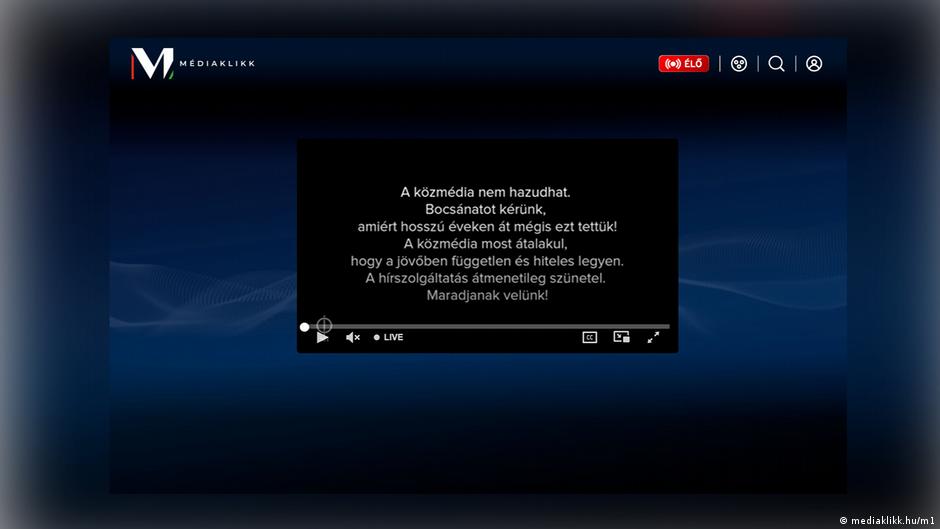
Shortly before 4 o’clock tv-watchers could read the following text on the black screen of M1: „Public media should not lie. We are sorry for doing it for so long. Public Media now will be reformed to be independent and trustworthy in the future. Our news program is currently suspended. Stay with us!” And in the evening one of the iconic Hungarian films „Tanú” („Witness”) – a kind of caricature of the hated Rákosi-years of the 1950s – entertained the public of M1. The once famous and longtime the only frequency in Hungary, Kossuth Radio has taken over the popular classical music program of Bartok Radio. Prime Minister Magyar quickly reacted on Facebook, on his favourite platform: „A historic day. Today marks the end of propaganda broadcasts on public media platforms. They lied at night, they lied during the day, they lied on every wavelength. That is now over.” Here lies the symbolic significance of this mediapolitical event: to break sharply with the propaganda nature of Public Media during Mr. Viktor Orban’s 16 years. To the Hungarian public „they lied at night…” sounds common, because this was a famous slogan of the revolution in 1956; these are the words of a famous Hungarian writer and were transmitted at the very beginning of the uprising; but it has to be added that there is huge distance between the typical Stalinist dictatorship of Matyas Rakosi and the hybrid regime of illiberal election autocracy of Mr. Orban. No comparison at all. Having said that it is absolutely true that the Fidesz Party and its leader, Mr. Orban centralised not only the public tv channels and radio frequencies, but also the Hungarian News Agency (MTI) as the centerpiece of the news system. An estimated 80% of the whole Hungarian media system was controlled by their loyal leaders being either directors of the non transparent media organisations or editor-in-chiefs in the media institutions. Due the overcentralised mechanism it was not difficult to change the main news sevices in to government mouthpieces – on practically every political field – and by personal insults demonising Gyorgy Soros, Ursula von der Leyen or Volodymyr Zelensky, always according to the up-to-date political interest. The other side of the fence is that the remaining 20% of the media could do real journalistic work, especially the merits of the investigating portals have to be underlined; it should be enough to quote that two years ago, the abdication of the previous Head of State, Katalin Novak was inspired by an investigating portal, and as it has turned out later, this was the beginning of the end of Orban’s era.
The leading media institutions collapsed like a house of cards of the 16 years, the illiberal mediapolitics of Mr. Orban, but inspired new processes, argues Mr. Gabor Polyak, media reserchear, university professor. What are beneath the ruins? The almost fully disrupted mediamarket – distorted by state orders -, the trust in journalists, which is at the lowest level in Europe, according to Reuters Institute Digital News Report -, and closely connected to this the normal relations between politicians and journalists are also under the ruins. I would add another victim of the destruction: serious political daily newspapers are also beneath the ruins; for the time being Hungary is probably the only EU-country where there is no national pint daily with serious content. And maybe even more grave is the assumption that during Orban’s 16 years the greater part of the society has lost its intellectual capacity to differenciate between news and manipulation, journalism and propaganda. And let us not forget that the situation is aggravated by the loudly knocking big platforms and the AI. All this has to be solved by the Tisza government? However Mr. Magyar and his fellow colleagues have to tackle the deep crisis in the state budget, in health, education, on the field of culture, they have to struggle against corruption, to restore rule of law – and all these enormous tasks seem to be much more important than a new, professional, autonomous Public Media, more essential than the disappearing of national political dailies and local newspapers as well. It might be true, that everything is more important, but – as we know – media in the broadest sense is connected with everything, every important part of our daily life. A small, but important example from the new government’s praxis: the minister of Health – unlike his predecessor – has opened the doors of the hospitals before the press, because the vital problems must not be swept under the rug, but all facts should be available for the public.
There is no need to reinvent the wheel: there are viable media models in front of our eyes with transparent structures, there are practices how to support quality journalism, how to organize Public Media – from the BBC to ZDF or the Scandinavian models –, and how to limitate state, government, business and lobby pressures on media. Of course no perfect recipes are available, but with the cooperation of media researchers and leading journalists, with the help of professional civil organisations now we have at least the hope to arrive to a transparent media system without state capture. Will it be very difficult? It will.
But we should not forget, what the late Anna Lindh (1957-2003), the brutally assassinated Swedish politician has said: „Resignation is our greatest enemy”.