
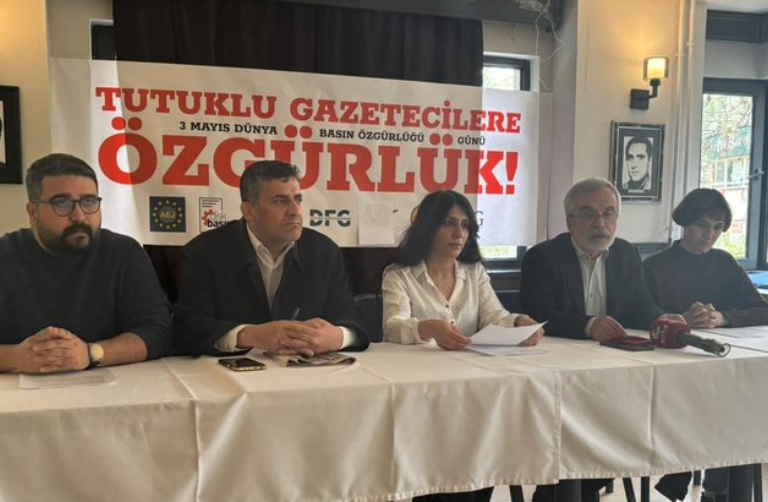

Turkey, in terms of press and freedom of expression, is unfortunately experiencing days that do not befit its own history with each passing year. Having fallen four places further in the press freedom index, our country has dropped to 163rd out of 180 countries.
May 3 has become a symbol of a deep crisis in terms of press freedom. Journalistic activities are increasingly being criminalized; reporting, revealing the truth, and informing the public are being portrayed as if they were criminal acts. One of the most concrete indicators of this climate of pressure is the journalists held in prisons.
Today in Turkey, many journalists are in prison—either detained or convicted—because of the news they report, the articles they write, their social media posts, or their duty to inform the public. Detentions lasting months or even years, files without indictments, trials based on secret witness testimonies, and the classification of professional activities as “crimes” are incompatible with the principles of the rule of law. Journalists in prison are deprived not only of their freedom but also of their right to practice their profession. This situation directly constitutes an interference with the public’s right to access information.
The imprisonment of journalists means that society is cut off from the truth. When journalists are silenced, workers’ resistance becomes invisible, the rights of laborers go unheard, and the voices of women, youth, and all oppressed groups are suppressed. Every attack on press freedom is also an attack on society’s right to democracy.
In Turkey, media workers are also under severe economic and political pressure. The monopolization of media ownership, the transfer of public resources to pro-government media outlets, and the systematic weakening of independent journalism are spreading self-censorship and narrowing the space for critical reporting. Our colleagues working without job security are, unfortunately, struggling to survive under conditions of poverty within this system. Today, this threat applies to all journalists, regardless of whether they are close to or critical of the government. The main reason younger colleagues are beginning to avoid practicing our profession is precisely these anti-democratic measures and lack of job security. Journalists are being forced to continue their profession within a triangle of unemployment, precarity, and pressure.
Journalism is not a crime. There should be no journalists in prison. Pursuing the truth and defending the public’s right to information is not a crime but a public responsibility.
In this regard, our demands are clear:
• All journalists held in prisons must be released immediately.
• All practices that criminalize journalistic activities must be ended.
• Legal regulations restricting press and freedom of expression must be abolished.
• Secure working conditions for journalists must be ensured, and obstacles to union rights must be removed.
It should not be forgotten: there is no democracy without a free press. In a country where journalists are not free, society is not free either.
We, the undersigned professional organizations, declare on May 3 World Press Freedom Day that we stand in solidarity with all imprisoned journalists and salute all our colleagues who refuse to give up defending the truth.
Association of European Journalists (AEJ) – Turkey Representation
DİSK Press Workers’ Union
Contemporary Journalists’ Association
Dicle Fırat Journalists’ Association
Southeastern Journalists’ Association
KESK Media Workers’ Union
Mesopotamia Women Journalists’ Association